ACT-2 Preview: Generalizing Reliability
July 17, 2026
Read article
The final step towards fully autonomous home robot deployment
In 1903, the Wright brothers’ first flight lasted twelve seconds. It proved powered flight was possible, decades before flying became safe and commonplace. Robotics is producing its own first flights: demos that make new capabilities visible and expand what the field can imagine. But as those capabilities mature, the field must also measure reliability: how performance holds as conditions change.
Today, we preview ACT-2, the first robotics model to achieve reliability by unifying broad generalization with high performance. Its central advance is that we can hill-climb performance with an in-house iteration loop and generalize the performance gains across unseen environments. This is possible because we discovered, for the first time, that a single fine-tuning example can teach our pretrained model a new behavior that generalizes. This breakthrough redefines the scaling equation for robotics: minimal in-house data can drive improvements across the real-world long tail. The result is 99.1% zero-shot success on laundry folding across diverse unseen environments.
ACT-2 builds on ACT-1, which we introduced in November 2025, to demonstrate long-horizon mobile manipulation, generalization to unseen homes, and advanced dexterity independently within one full-stack system.111“ACT-1: A Robot Foundation Model Trained on Zero Robot Data” (2025). ACT-1 expanded the frontier of what robot foundation models could do. ACT-2 takes the next step: establishing how reliably those capabilities hold as the world changes around them.
ACT-2’s central breakthrough is that reliability gains from rapid post-training iterations on in-house Memos generalize to unseen, real, home environments. The key unlock is to close the generalization gap through a strong base model. ACT-2 is pretrained on a high-quality, high-diversity, sensorized human dataset collected through Sunday’s proprietary data collection hardware, data curation system, and data processing pipeline.
This breaks the long-standing tension in robot learning. Training on diverse data makes models general, but their behaviors are not necessarily reliable. Narrow, curated data can produce performant policies, but those gains often remain tied to the environments where the data was collected. ACT-2 brings the two together: as pretraining scales with diverse data, post-training on curated data becomes more sample-efficient and generalizable.
We demonstrate the strength of the recipe through three insights. One, we measure how scaling pretraining narrows the generalization gap between in-domain and out-of-domain performance. Next, we show what that enables: teaching the model a new generalizable behavior from a single example. Finally, we share how this mechanism enables a quick loop for continual improvement. Because ACT-2 learns so efficiently, our post-training process can close reliability gaps quickly as failures surface. Together, these ingredients allow ACT-2 to achieve 99.1% zero-shot success on laundry folding in diverse, unseen homes.
Narrow post-training can improve reliability in the environments where new data is collected, while producing much smaller gains under unseen conditions. This is commonly called overfitting: making the model more reliable in-house without making it more reliable in the wild. To quantify this, we define the generalization gap as the difference between in-domain and out-of-domain success after post-training.
Our key finding is that scaling pretraining closes this gap. As the pretrained model becomes stronger, gains learned from a small amount of in-house data become increasingly transferable rather than remaining tied to the environments where that data was collected.
To measure this, we apply the same post-training procedure at each pretraining scale, then evaluate the resulting models on two distributions: the environments represented during post-training, which we call in-domain, and held-out environments, objects, and configurations, which we call out-of-domain.
The generalization gap falls sharply with pretraining scale. As the gap shrinks, in-house performance becomes a reliable predictor of performance in the wild. This lets us hill-climb locally with confidence that the gains will hold in unseen homes.
Scaling Pretraining Closes the Generalization Gap
Gap Between In- vs Out-of-Domain
| Pretrain data scale | In-domain SR | Out-of-domain SR | Generalization gap |
|---|---|---|---|
| 0% | 96% | 14% | 82 |
| 12% | 100% | 90% | 10 |
| 25% | 100% | 92% | 8 |
| 50% | 100% | 96% | 4 |
| 100% | 100% | 100% | 0 |
Scale alone is not enough. The quality and composition of the pretraining data also determine how efficiently the model improves. At matched data volume and compute, higher-quality data produces lower validation loss and higher downstream success. We also found a strong correlation between validation loss and success rate, giving us a practical signal for improving the data mixture before running expensive physical evaluations.
Scaling Pretraining Yields Predictable Improvements
Success Rate vs. Pretraining Scale
Validation Loss vs. Pretraining Scale
Success Rate vs. Validation Loss
| Pretrain data scale | Success rate | ±1 SE | Validation loss |
|---|---|---|---|
| ★ Flagship model | |||
| 100% | 99.1% | 98.8–99.4% | 0.0653 |
| High-quality subsampling | |||
| 12.5% | 75.6% | 68.5–81.2% | 0.0700 |
| 25% | 87.9% | 85.3–89.9% | 0.0682 |
| 50% | 92.3% | 85.4–94.6% | 0.0668 |
| Uniform subsampling | |||
| 12.5% | 43.8% | 39–50.4% | 0.0738 |
| 25% | 53.6% | 50.5–56.7% | 0.0713 |
| 50% | 64.1% | 55.7–70.5% | 0.0682 |
As the generalization gap narrows, each post-training example gains more leverage.222Language models showed that scaling pretraining can sharply reduce downstream adaptation: GPT-1 still required task-specific fine-tuning, while GPT-3 could perform many tasks from a prompt and a few examples. Robotics is beginning to show the same pattern: π0 showed that broad pretraining can support the rapid acquisition of new skills through fine-tuning, while GEN-0 and GEN-1 report that scaling physical pretraining reduces the task-specific robot data required, reaching roughly one hour for GEN-1’s reported tasks. “GPT-1” (2018); “GPT-3” (2020); “π0” (2024); “GEN-0” (2025); and “GEN-1” (2026). To our knowledge, we are the first to demonstrate that an end-to-end model can learn new behaviors from a single demonstration and generalize those behaviors to unseen environments.
We post-trained four independent copies of the same pretrained model using simple Supervised Fine-Tuning (SFT). Each copy received one demonstration of a different folding technique. We then evaluated every checkpoint on a held-out garment, unseen during our SFT runs. All four models successfully executed their newly learned techniques.
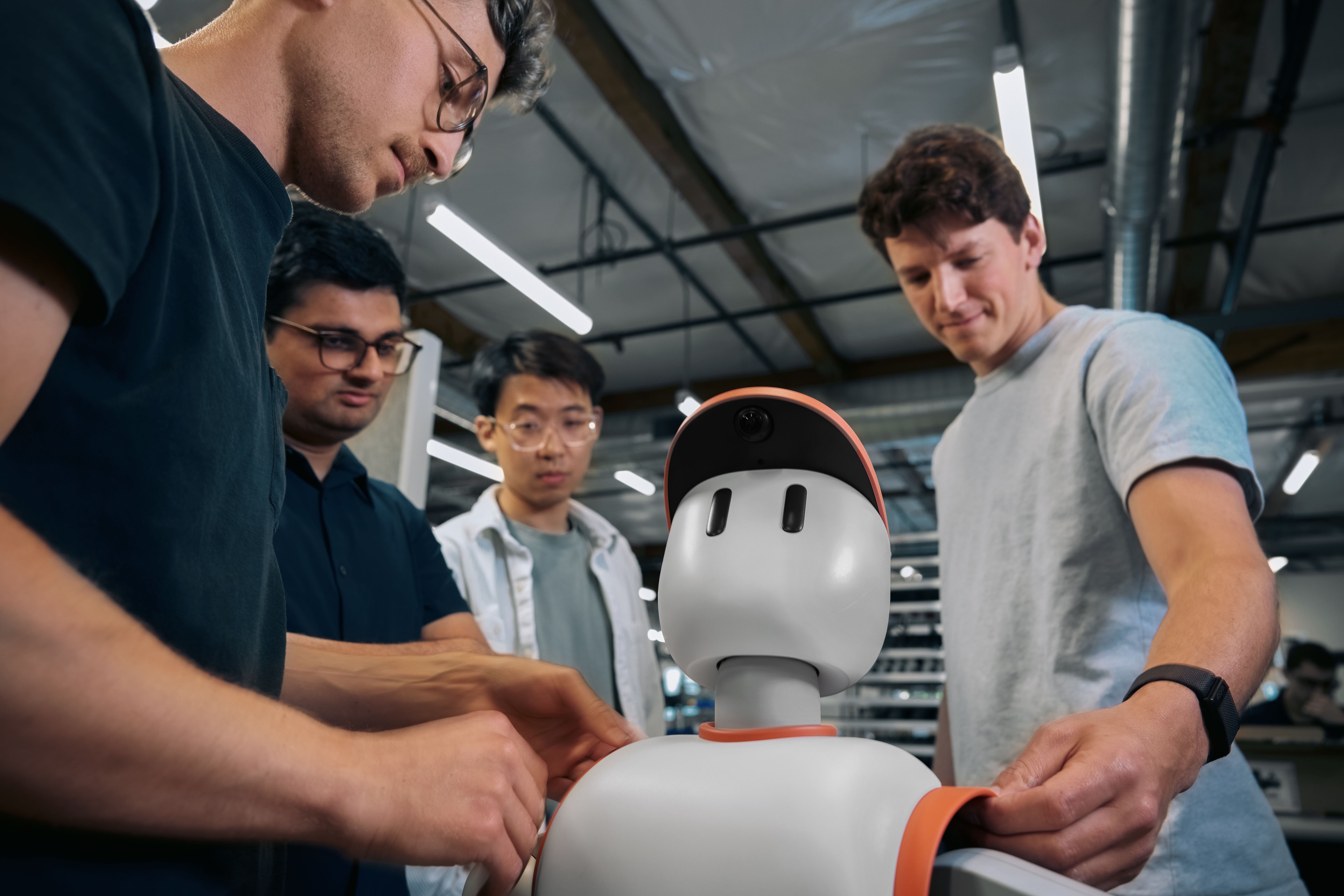
Pretraining gives ACT-2 the capacity to generalize in unseen environments, but one-off demonstrations are insufficient. The remaining gap to deployment-level reliability and performance comes from difficult edge cases and failures that appear only after the policy is run repeatedly in the real world. The same generalization capacity that allows our model to learn new behaviors from a single demonstration also allows our model to learn efficiently from recoveries. Our post-training loop targets these gaps directly. Because we own the robot, model, fleet infrastructure, and data operation end-to-end, the full improvement loop can happen very quickly. We will cover more details about our post-training in a separate technical post.
Home robotics has a property we believe is unique: research-market fit. The same requirements that make home robots useful also point toward general intelligence. Homes are spaces of infinite variation, long tails and constant change. As such, the scope of a home robot cannot be narrow. To create real value, it must perform reliably across open-ended variation with no special setup, and that is a practical test of embodied general intelligence. The market rewards exactly what the research demands: intelligence that generalizes, improves, and compounds across the fleet.
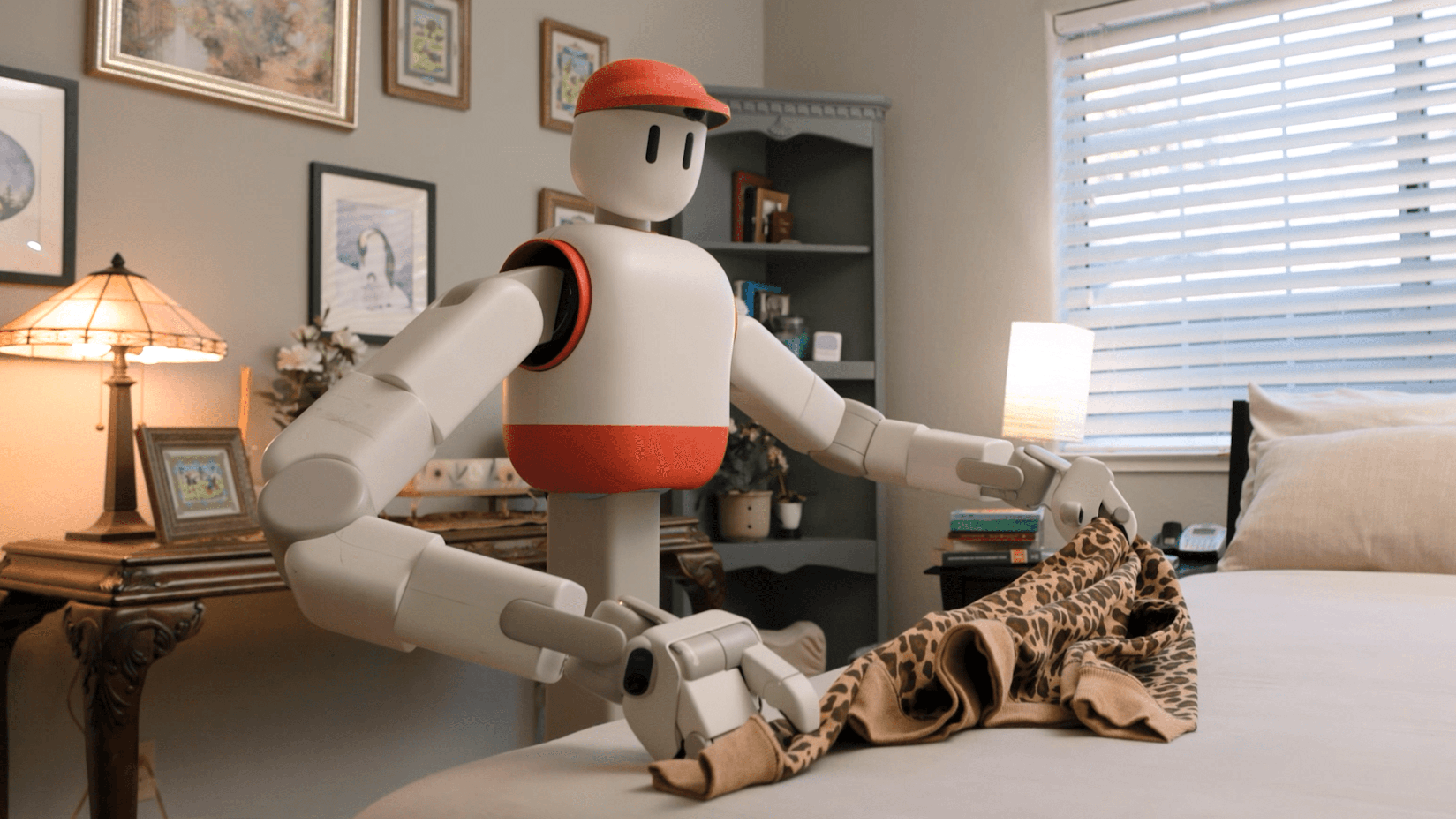
Laundry folding is where we begin testing that proposition. It’s an everyday home capability, but also a concentrated version of the broader challenge: success requires a robot to handle enormous variation in objects and starting states. Garments deform, self-occlude, vary widely in construction, and rarely appear in the same state twice. This combination of practical value and manipulation complexity makes laundry folding a challenging first task, and the recipe behind it is built to extend far beyond laundry.
We evaluate ACT-2 against a standard called a Solve: reliable performance across a declared scope, at a stated adaptation cost. We introduce the full framework later in the article. Here, we first define the boundary within which ACT-2’s performance should be interpreted.
| Scope | Adaptation cost | |
|---|---|---|
| Garments | Household items that are commonly folded and fold quality can be evaluated consistently — T-shirts, long-sleeved tops (thick and thin), polos, sleeveless tops, blouses, pants, leggings, and shorts — across different sizes (XXS to 8XL), colors, materials, thicknesses, and textures. Socks, bras, underwear, and accessories are excluded: their normal treatment is pairing, sorting, or hanging rather than folding. | Zero per home. No home- or garment-specific data at deployment, no expert demonstrations in the target home, no post-training. All evaluation cases use the same model checkpoint and system configuration. |
| Scenes | Unseen rooms, varied beds and folding surfaces, different lighting, folding from either side or the foot of the bed. | |
| Initial configurations | Garments starting in baskets, piles, on beds, or on the ground — arbitrarily oriented and naturally crumpled. |
These boundaries define the claim behind ACT-2’s result. The 99.1% success rate reflects performance across the declared distribution, using the same model checkpoint and with zero per-home adaptation. To our knowledge, this is the largest-scope, lowest-adaptation-cost result reported for a real home manipulation capability, and our first evidence that the long tail can be solved with a general, scalable recipe.333No data from the evaluation homes or their physical garments were used for task-specific post-training or model selection, and model weights remained fixed throughout the reported evaluation.
99.1%± 0.3%
overall success rate
778
successful folds
9
garment types
All fold attempts were graded by a team of annotators using a purpose-built grading tool. Each attempt was classified as a success or failure, and successful folds were scored against the quality rubric below. Grading ran in two rounds: one annotator assigned the initial grade, and a second independently reviewed it, with differences resolved by the review lead. Annotators were trained on a set of reference folds before grading began, and the rubric was fixed before evaluation and not revised afterward. Every evaluation video can be seen in more detail here.
An attempt is successful when the garment is folded and stacked autonomously.
Across 785 autonomous attempts spanning 9 major garment types, ACT-2 achieved an overall success rate of 99.1% (±0.3% standard error).
We analyzed performance by garment type, starting configuration, robot position, and bed sheet color. Success remained high across categories: shorts, long-sleeved tops (thick and thin), polos and sleeveless tops achieved the highest success rate at 100%, while blouses had the lowest success rate at 94.7%444We hypothesize that blouses are more challenging because their lightweight, highly deformable construction provides fewer stable geometric cues for grasping and alignment. These results don’t reflect a fixed capability ceiling for users. We are working to improve the model performance with our tight post-training loop..
Success Across Garments
785 autonomous attempts • standard error
| Category | Success | ±1 SE | Attempts |
|---|---|---|---|
| Overall | 99.1% | 98.8–99.4% | 785 |
| Shorts | 100% | — | 98 |
| Long-sleeved tops (thick) | 100% | — | 85 |
| Long-sleeved tops (thin) | 100% | — | 79 |
| Polos | 100% | — | 46 |
| Sleeveless tops | 100% | — | 7 |
| T-shirts | 99.0% | 98.5–99.6% | 312 |
| Pants | 98.8% | 97.7–100% | 85 |
| Leggings | 96.3% | 93.7–98.9% | 54 |
| Blouses | 94.7% | 89.6–99.9% | 19 |
Success Across Environments
785 autonomous attempts • standard error
*Sheet color groups overlap
| Group | Category | Success | ±1 SE | Attempts |
|---|---|---|---|---|
| Starting Configuration | Pile on bed | 98.8% | 98.4–99.3% | 514 |
| Starting Configuration | Basket on bed | 100% | — | 73 |
| Starting Configuration | Basket on ground | 99.5% | 99–100% | 198 |
| Robot Position | Left of bed | 98.7% | 98.1–99.4% | 315 |
| Robot Position | Right of bed | 100% | — | 271 |
| Robot Position | Foot of bed | 98.5% | 97.6–99.4% | 199 |
| Bed Sheet Color | Light | 99.2% | 98.9–99.6% | 527* |
| Bed Sheet Color | Dark | 98.0% | 96.8–99.1% | 149* |
| Bed Sheet Color | Colored (other hues) | 99.6% | 99.3–100% | 273* |
Folding is a demanding manipulation problem. ACT-2 must reason about deformable cloth, align corresponding edges, and preserve the fold through regrasping and stacking. Those technical challenges ultimately matter because they determine the quality of the fold a user receives. We therefore judge each fold by whether it is neat, compact, complete, and stable in a stack.
We evaluated every completed fold using a five-star rubric based on these qualities. Each fold begins at five stars, with one star deducted for each flaw category present:555We use a two-inch threshold because excess or misaligned material beyond that point produces noticeable bumps in the fold and makes the garment harder to stack neatly.
Rubric
Across 778 completed folds, ACT-2 achieved a mean score of 4.72/5: 98.3% met the four- or five-star quality bar, including 73.8% that received a perfect score. Among the well-sampled garment types included in our evaluation distribution, the average quality ranges from 4.63 for polo shirts to 4.88 for leggings.
Quality Remains High Across Garment Types
778 completed folds • star composition overall and by garment type
Across 778 Completed Folds:
4.72of 5 ★
mean fold quality
98.3%
rated 4★ or 5★
9
garment types
| Garment | 3★ | 4★ | 5★ | Mean | n |
|---|---|---|---|---|---|
| Overall | 1.67% | 24.6% | 73.8% | 4.72 | 778 |
| Sleeveless tops | 0% | 0% | 100% | 5.00 | 7 |
| Leggings | 0% | 11.5% | 88.5% | 4.88 | 52 |
| Pants | 0% | 17.9% | 82.1% | 4.82 | 84 |
| Shorts | 1.02% | 20.4% | 78.6% | 4.78 | 98 |
| Long-sleeved tops (thick) | 1.18% | 21.2% | 77.6% | 4.76 | 85 |
| T-shirts | 1.94% | 29.4% | 68.6% | 4.67 | 309 |
| Long-sleeved tops (thin) | 2.53% | 29.1% | 68.4% | 4.66 | 79 |
| Polos | 4.35% | 28.3% | 67.4% | 4.63 | 46 |
| Blouses | 5.56% | 27.8% | 66.7% | 4.61 | 18 |
To put these scores in context, we show ACT-2 and a human folding matched garments side by side. In these examples, ACT-2 produced folds similar in alignment, compactness, and stack stability.
We measure completion time from the moment ACT-2 begins retrieving a garment to when it adds the folded garment to the stack, including autonomous retries and recovery. Across 778 successful attempts, ACT-2 completed the task in a median of 2 min 13 sec and a mean of 2 min 19 sec. Completion time varied by garment type, reflecting differences in garment geometry and manipulation complexity.
Completion Time of Successful Folds
Overall and by garment type
| Garment | Median | Mean | 10th | Q1 | Q3 | 90th | n |
|---|---|---|---|---|---|---|---|
| Overall | 2.22 | 2.32 | 1.36 | 1.86 | 2.64 | 3.24 | 778 |
| Shorts | 1.23 | 1.33 | 0.88 | 1.03 | 1.39 | 1.79 | 98 |
| Sleeveless tops | 1.87 | 1.85 | 1.61 | 1.76 | 1.95 | 2.09 | 7 |
| Pants | 2.06 | 2.28 | 1.45 | 1.72 | 2.67 | 3.46 | 84 |
| Blouses | 2.21 | 2.48 | 1.74 | 2.03 | 2.41 | 3.34 | 18 |
| T-shirts | 2.25 | 2.32 | 1.83 | 2.01 | 2.51 | 2.90 | 309 |
| Leggings | 2.27 | 2.54 | 1.55 | 1.81 | 2.82 | 3.65 | 52 |
| Polos | 2.31 | 2.65 | 1.97 | 2.11 | 2.93 | 3.98 | 46 |
| Long-sleeved tops (thick) | 2.36 | 2.60 | 1.90 | 2.12 | 2.83 | 3.27 | 85 |
| Long-sleeved tops (thin) | 2.73 | 2.98 | 2.10 | 2.43 | 3.24 | 4.00 | 79 |
One of the most striking aspects of ACT-2 has been how often the model surprises us. Large-scale pretraining produces behaviors that were not explicitly instructed but emerge under long-tail conditions: edge-case recovery, robustness under disturbance, and whole-body manipulation that lets Memo extend its working range beyond the workspace of a tabletop robot.
Edge-Case Recovery
Real homes produce messy intermediate states: garments fall to the floor and clothing arrives crumpled, leading to occlusion and making parsing difficult for robots. ACT-2 treats these states as recoverable rather than dead ends: it can retrieve clothing from the floor, reorient garments, continue folding after the state changes, and make emergent fine-grained adjustments to ensure high-quality folding.
Clothes on the ground
In-the-wild recovery
In-the-wild fine adjustment
Robustness Under Disturbance
Homes are not controlled environments. Memo’s workspace is shared with humans, which introduces constant change and disturbance. ACT-2 remains reliable under these perturbations: it can replan and continue the task instead of following a fixed sequence.
Child interaction
Adversarial perturbation
Dark and bright
Beyond a Fixed Tabletop Workspace
Folding laundry requires a wide physical range. Baby clothes (16″ × 8″), 8XL oversized shirts (38″ × 42″), and large towels (53″ × 28″) differ not only in size, but also in the workspace and manipulation strategies they require. This is where the full-stack approach matters: ACT-2 runs on a general-purpose mobile body rather than a fixed tabletop rig. Memo can reposition, adjust its height, and lean into the workspace, expanding the operating range of the model.
8XL shirt
Baby clothes
Towel
The results above describe how ACT-2 performs. But performance alone does not establish the significance of a capability; it must be interpreted alongside the range of conditions under which it is reliable, and the adaptation required to achieve it.
A 99.1% success rate across unseen homes with zero adaptation represents a fundamentally different claim from 99.1% measured on one garment, one prepared surface, and one familiar room, even though both percentages are the same.
This is why demos are a poor measure of progress. Each demo is shaped by its own environments, objects, starting states, preparation, and intervention rules. Without a consistent way to describe those conditions, results are difficult to compare or build upon.
We propose a standard that makes the full claim explicit. We call it a Solve: reliable performance across a declared scope, at a stated adaptation cost.
Every Solve has three components:
Together, a Solve makes robotics progress comparable and cumulative. Once scope and adaptation cost are specified, metrics such as success, quality, and speed become meaningful. Only then, can we measure whether a policy’s useful operating range is expanding, deployment requirements are falling, and performance is improving within the boundary.
We evaluated ACT-2 against this standard. The scope and adaptation cost were declared before evaluation, the rubric was fixed in advance, and the grading process documented. Under this framework, ACT-2’s result represents more than a high success rate, showing that the same model can sustain high reliability across broad real-world variation without deployment-specific adaptation.
This ACT-2 preview introduces laundry as our first Solve, but the larger result is a recipe that can turn limited in-lab data into behaviors that transfer broadly. ACT-2 does not start from scratch with each new capability.
The same base model is already learning a broader set of household capabilities, including vacuuming, toy organization, fastening zippers, turning pants inside out, and coffee preparation. These capabilities have not yet been tested against the standard of a Solve, but each exercises a different strength of the shared model: tool use, organizing cluttered spaces, precision manipulation, and long-horizon reliability.
Vacuuming
Toy organization
Zipping
Coffee
Inside-out pants
Progress across capabilities may be uneven. General intelligence does not require every behavior to advance at the same rate. A robot that performs every task at 60% reliability may be less useful than one that performs a smaller number of valuable tasks reliably. Pushing one valuable capability across its deployment threshold creates a useful system today and a flywheel for improving the model.
Each Solve makes the next one easier. The data and methods developed for laundry strengthen shared behaviors that transfer across other tasks. ACT-2 provides a repeatable scaling recipe: improve with limited in-house data, transfer the gains broadly, and build each new capability on a stronger foundation. Over time, Memo will not be defined by any single task, but by its ability to learn and reliably take on whatever the home requires.
In 1914, eleven years after those twelve seconds, the first airline began scheduled service on one route across Tampa Bay, twice a day. This shift was significant because it meant that flying became reliable enough to support regular use and once it did, aviation scaled from one route to a global network.
Just as aviation moved from proof of possibility to reliable service, ACT-2 moves Sunday from demonstrating what Memo can do to generalizing its reliability across real-world variation. From there, robotics enters an accelerating phase. Intelligence compounds as every improvement propagates across the fleet and every new capability makes the next easier to learn.
This fall, we will deploy Memo to families through our Beta Program. It’s a step toward a near future where general-purpose robots become a trusted part of everyday life: useful across homes, adaptable to the unexpected, and rapidly expanding the set of capabilities people can rely on.
Footnotes
We’re building physical general intelligence — the robot, the model, the fleet, and the data engine, end to end. If solving the long tail excites you, come build the next Solves with us.
See open rolesPlease cite this work as:
Or use the BibTeX entry:
@article{sunday2026act2preview,
  author  = {Sunday Robotics},
  title   = {ACT-2 Preview: Generalizing Reliability},
  journal = {Sunday Robotics Blog},
  year    = {2026},
  month   = {jul},
  url     = {https://www.sunday.ai/blog/act-2-preview}
}The dishes can wait.